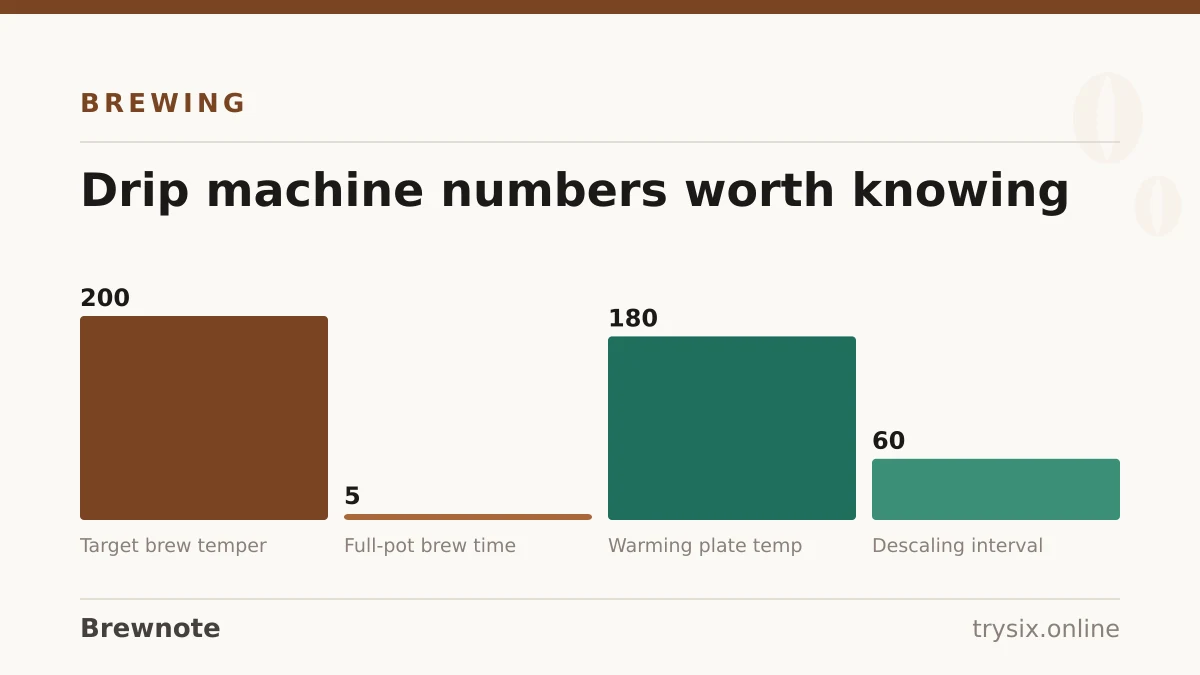
Drip machines are the most common way coffee gets made and the least often read about, so most people work theirs out by trial and error and never quite fix the parts that are off. A few small changes — the dose, the filter, and descaling — turn a mediocre machine into a genuinely good one.
Where everything goes
Every drip machine has the same four parts, whatever it costs. A water reservoir, usually at the back with a hinged lid. A filter basket, in a swing-out or lift-up holder above the carafe. The carafe itself, on a warming plate. And a shower head above the basket that you probably never look at.
Making a pot, step by step
Step 1: Fill the reservoir with cold water
Lift the lid at the back and pour cold water in to the marking for the number of cups you want. Cold, not hot: the machine's thermostat is calibrated to heat it, and starting with hot water usually produces under-heated, under-extracted coffee.
Step 2: Fit the filter
Open the basket and drop in a paper filter — a #4 cone or a basket filter, depending on your machine's shape. If yours has a permanent gold-tone mesh filter, use that instead; no paper needed.
Step 3: Add the coffee
One level tablespoon of medium-ground coffee per marked cup. Level it out so water passes through evenly rather than channelling down one side.
Step 4: Close and start
Close the basket and the reservoir lid, make sure the carafe is seated properly under the basket, and press the switch. Many machines have a drip-stop valve that only opens when the carafe is in place.
Step 5: Wait, then remove the carafe
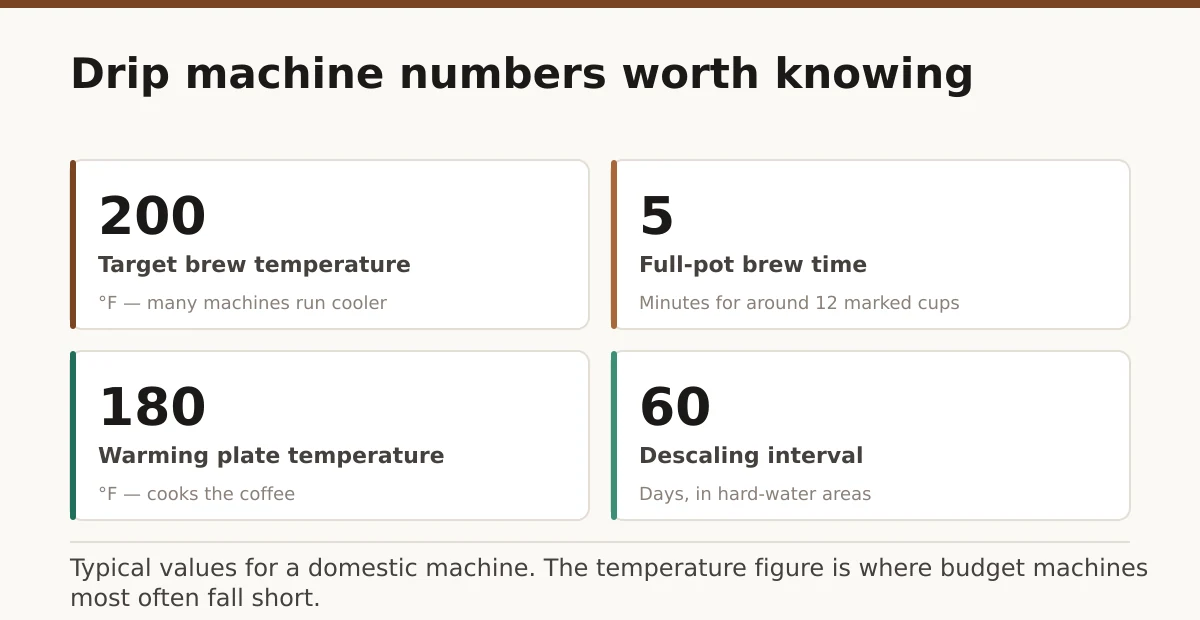
Four to six minutes for a full pot. Take it off the warming plate once it is done — see below for why.
How much coffee — and what 'cup' means
The single most confusing thing about drip machines is that a 'cup' on the carafe is not a cup you drink from. Manufacturers use a 5 oz or 6 oz measure, not the 8 oz US cup and certainly not a 12 oz mug. A 12-cup machine holds about 60 oz — roughly 1.8 litres, or five to six mugs.
| Marked cups | Water | Coffee | Mugs it fills |
|---|---|---|---|
| 4 | 20–24 oz / 600–700 ml | 4 level tbsp / ~38 g | About 2 |
| 8 | 40–48 oz / 1.2–1.4 L | 8 level tbsp / ~75 g | About 4 |
| 10 | 50–60 oz / 1.5–1.8 L | 10 level tbsp / ~94 g | About 5 |
| 12 | 60–72 oz / 1.8–2.1 L | 12 level tbsp / ~113 g | About 6 |
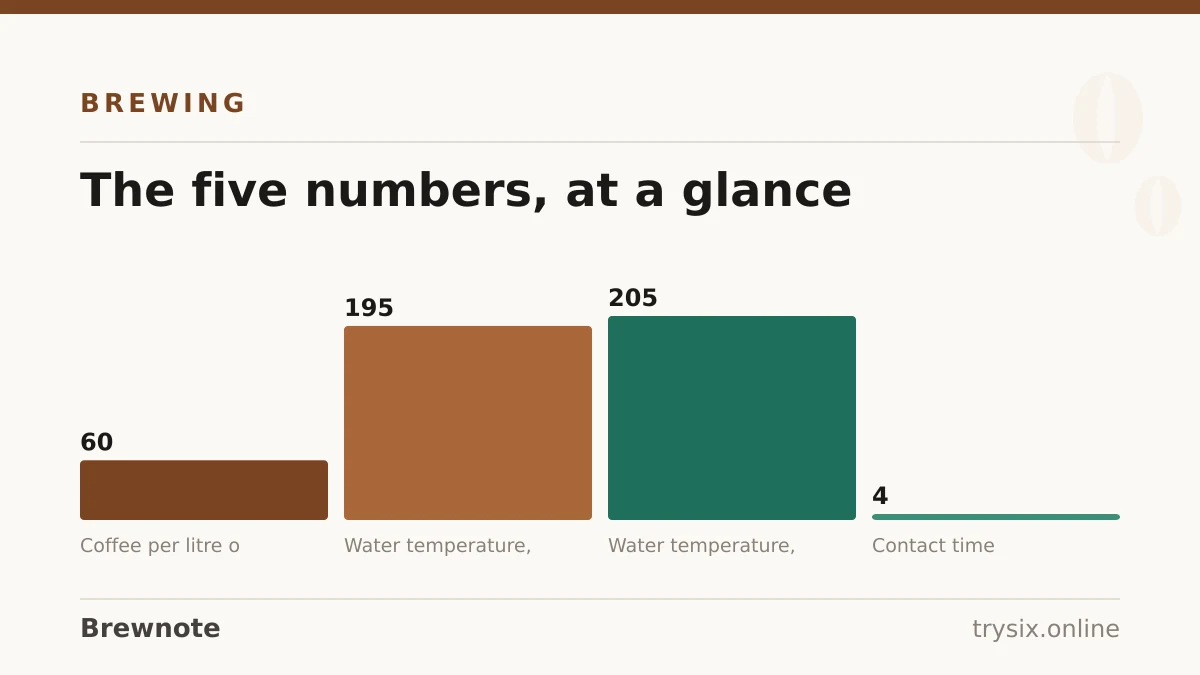
That works out close to the 1:16 ratio used everywhere else on this site. If you want to weigh instead — which is more consistent, since ground coffee density varies by roast — use 60 g per litre. How to make the perfect cup of coffee explains why weighing beats scooping.
How the machine works inside
There is no pump. Water flows by gravity from the reservoir into an aluminium tube running along the base, directly above the heating element. The element boils the water in that tube, and the resulting steam bubbles push slugs of hot water up a second tube to the shower head. That is why a drip machine gurgles: you are hearing the boil-and-lift cycle.
It also explains two of the machine's limitations. Because the water is briefly boiled and then cools on its way up, output temperature is often below the ideal 195–205°F, particularly on cheap machines. And because scale forms fastest on the hottest surface, the heating tube is where limescale accumulates and where it does the most damage.
Filters: paper, mesh or cloth
| Filter | Cup | Cost | Note |
|---|---|---|---|
| Bleached paper | Cleanest; retains oils and diterpenes | Cheap, disposable | Rinse first to remove paper taste |
| Unbleached paper | Same, slightly more papery | Cheap, disposable | Rinsing matters more |
| Permanent gold mesh | Fuller body, some sediment | One-off purchase | Passes oils through |
| Cloth | Full body, very little sediment | Reusable, needs washing | Must be kept scrupulously clean |
Paper filters retain cafestol and kahweol, the diterpenes associated with modest increases in LDL cholesterol in unfiltered coffee. If that matters to you, paper is the choice; if body and mouthfeel matter more, mesh.
Cleaning and descaling
- After every pot: rinse the carafe and the basket. Coffee oils go rancid, and stale oil is the reason an old machine's coffee tastes off even with fresh beans.
- Monthly, or every 40 brews: descale. Fill the reservoir with equal parts white vinegar and water, run half a cycle, switch off for 30 minutes, then finish the cycle.
- Then run two full cycles of plain water to flush the vinegar out. Skipping this is how you get a pot that tastes of salad dressing.
- In hard-water areas, descale every one to two months. In soft-water areas, every three or four is plenty.
Getting more out of a basic machine
- Use filtered water. Coffee is 98.5 percent water, and it also halves how fast scale forms.
- Grind fresh, medium — the texture of coarse sand. How to grind coffee beans covers the sizes.
- Pre-wet the paper filter with hot water and discard the rinse. It removes the papery taste and warms the carafe.
- Do not brew half a pot in a 12-cup machine if you can avoid it. Small volumes cool faster on the way through, so extraction suffers.
- If your machine cannot get hot enough, brewing by hand is a genuine upgrade — how to make coffee without a coffee maker uses water you control directly.