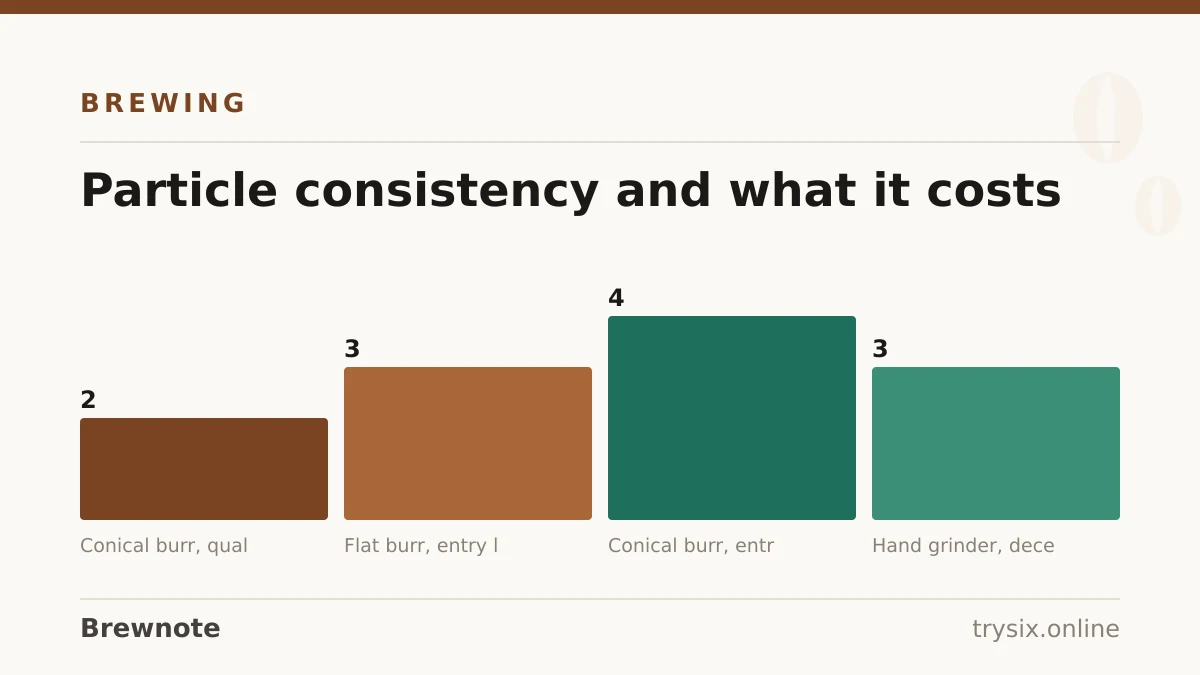
The grinder is the piece of equipment people buy last and should buy first. If your coffee tastes sour and thin one day and harsh the next, using the same beans and the same method, the grind is usually why. Here is how to match it to your brewer without guessing.
Why grind size matters more than almost anything
Water dissolves material out of the surface of coffee particles. Halve the particle size and you roughly double the surface area for the same weight of coffee, so extraction happens about twice as fast. That is the whole mechanism.
Which means grind is not a preference — it is the dial that matches your coffee to the time your brewer gives it. An espresso machine has 25 seconds, so it needs a fine grind. A cold brew jar has 16 hours, so it needs a coarse one. Use espresso grind for cold brew and you will get something undrinkably bitter; use cold brew grind for espresso and water will run straight through.
Grind size by method
| Method | Grind | Looks like | Contact time |
|---|---|---|---|
| Espresso | Fine | Table salt, slightly powdery | 25–30 seconds |
| Moka pot | Fine-medium | Between salt and sand | 3–5 minutes |
| AeroPress | Medium-fine | Fine sand | 1–2 minutes |
| Pour-over (V60, cone) | Medium | Coarse sand | 3–4 minutes |
| Drip machine | Medium | Coarse sand | 4–6 minutes |
| French press | Coarse | Raw sugar | 4 minutes |
| Cold brew | Coarse | Raw sugar, or coarser | 12–24 hours |
| Percolator | Extra coarse | Coarse sea salt | 4–6 minutes, recirculating |
If your bag says 'ground coffee' with no further description, it is almost certainly a medium drip grind — see what is ground coffee. That works acceptably in a drip machine and poorly everywhere else.
Burr versus blade
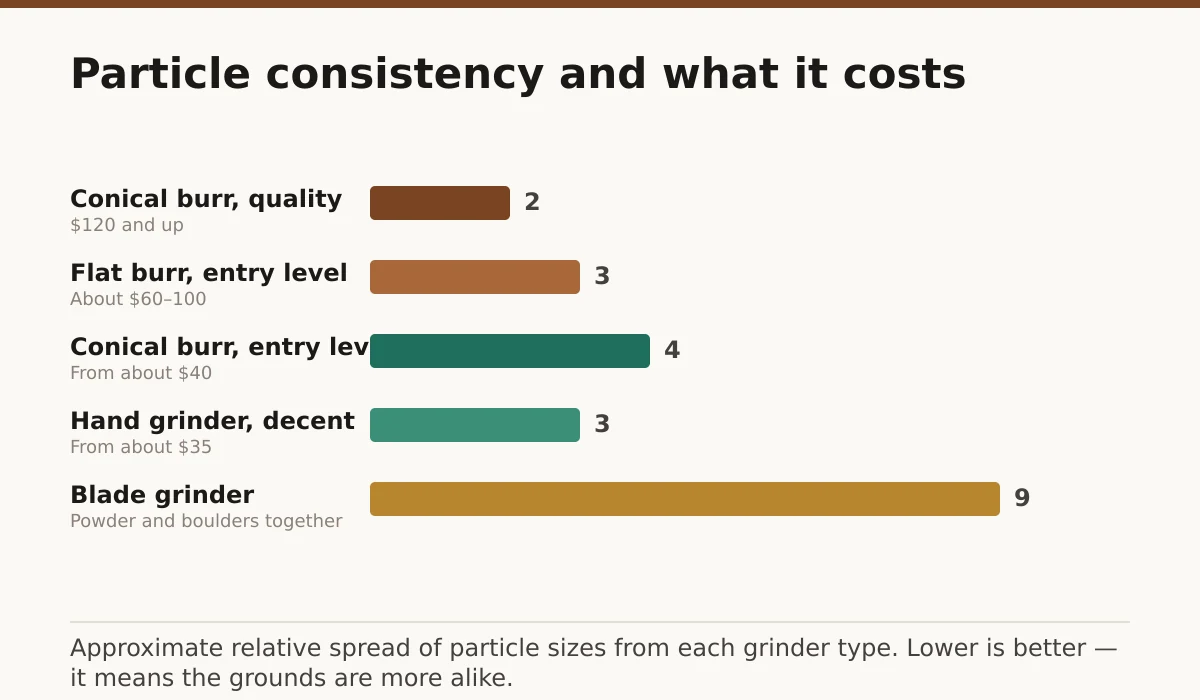
A burr grinder passes beans between two abrasive surfaces set a fixed distance apart. Nothing exits until it is small enough to fit through the gap, so particles come out at a consistent size. A blade grinder is a small propeller in a chamber: it chops whatever it hits, repeatedly, and what you get depends entirely on how long you run it.
The consequence is uneven extraction. Fine dust over-extracts and tastes bitter; coarse chunks under-extract and taste sour. A blade-ground cup contains both at once, which is why it can taste harsh and weak simultaneously — a combination that confuses people because the usual fixes work against each other.
Grinding for each brewer, in practice
Dialling in a new bag
Step 1: Start at the recommended setting
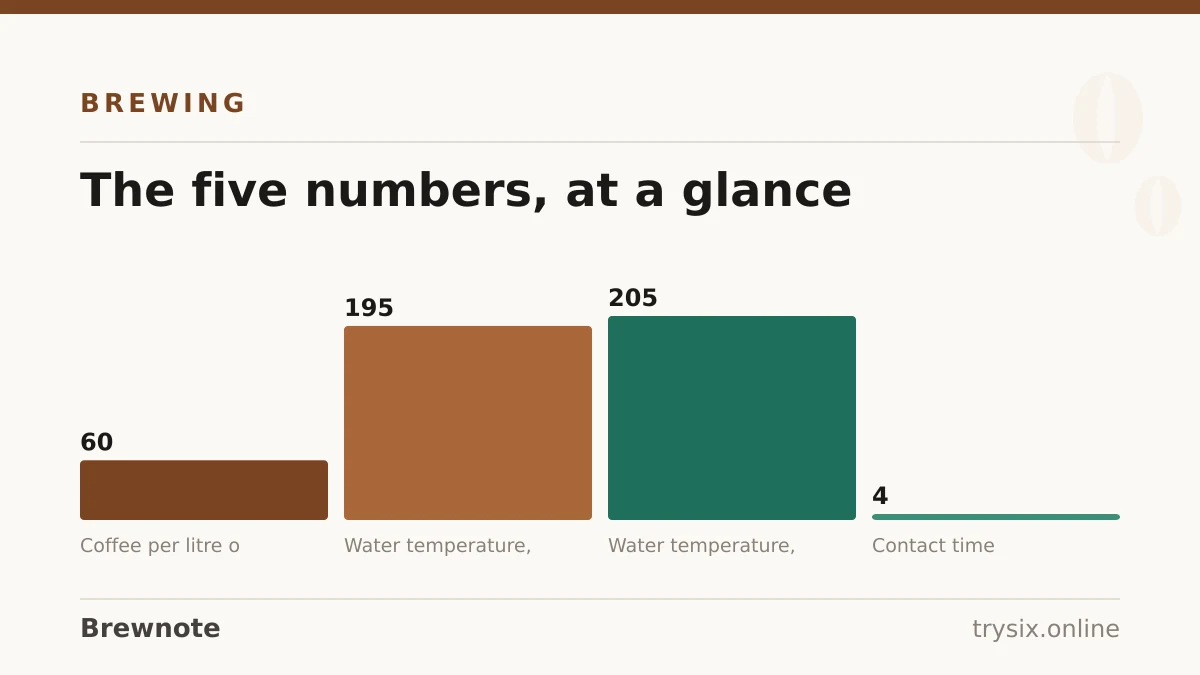
Whatever your grinder's manual says for your method. Weigh the coffee — 60 g per litre for most methods — so you are only changing one variable.
Step 2: Brew and taste for the fault, not the flavour
Ignore whether you like it for a moment. Ask whether it is bitter and drying, or sour and hollow. Those are the two directions.
Step 3: Move one step, not three
Bitter, go one step coarser. Sour, one step finer. Grinder settings are logarithmic in effect — a single click changes more than it looks like it should.
Step 4: Re-taste before changing anything else
Only when the sour-bitter axis is right should you adjust ratio for strength. Getting these out of order is why people chase their tail for weeks.
Grinding without a grinder
Whole beans can be broken down by hand, and the results are usable if you accept an uneven grind.
- Rolling pin: beans in a sealed freezer bag on a board, crushed rather than rolled. Press down and rock; do not roll, which slides them around. Gets you to a coarse-medium.
- Pestle and mortar: the most controllable manual option. Crush, do not grind in circles, and work in small batches. Can reach medium-fine with patience.
- Heavy pan: beans in a bag, whack with the flat base. Coarse and uneven, but fine for French press or a cold steep.
- Blender or food processor: pulse in short bursts. Produces a very wide spread, better than nothing for immersion methods and unsuitable for espresso.
The manual options all skew coarse, which suits immersion brewing — a French press, a cold brew jar, or a saucepan brew. None will get you to espresso fine, and attempting it produces mostly dust.
Where to have beans ground
Almost every independent roaster will grind a bag for you at the till, and most supermarkets with a bean section have a grinder next to it. Tell them the brewer by name — 'a Bialetti moka pot', 'a filter machine', 'a cafetière' — rather than saying fine or coarse, because those words mean different things to different people.
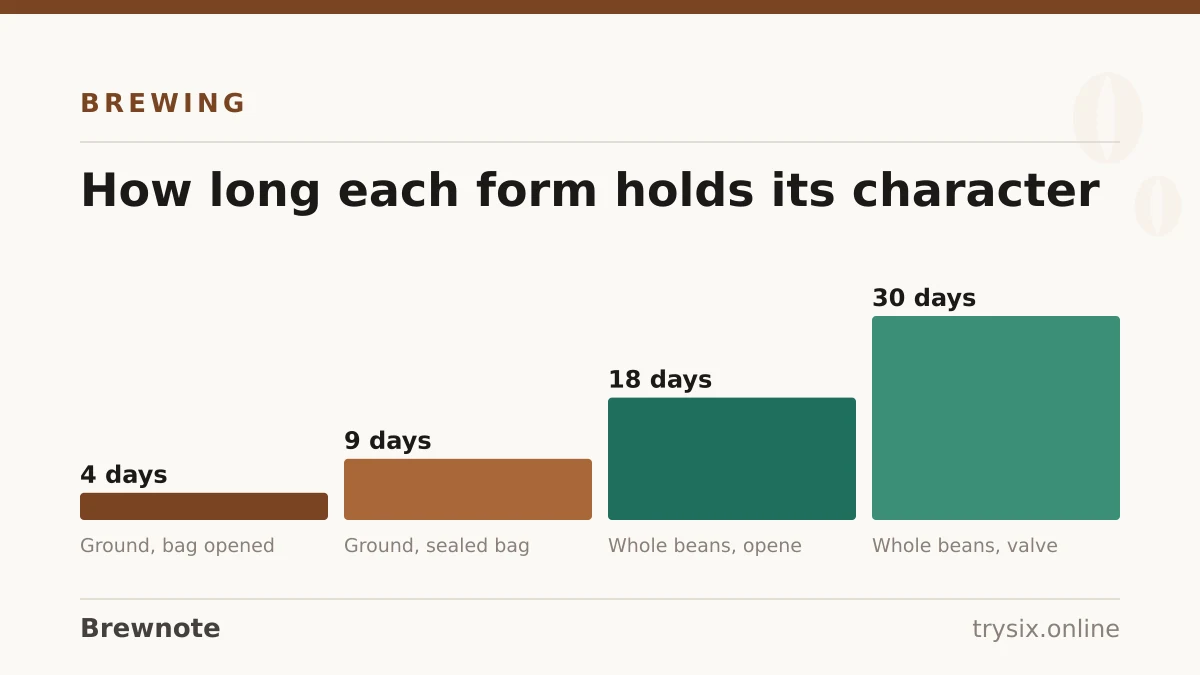
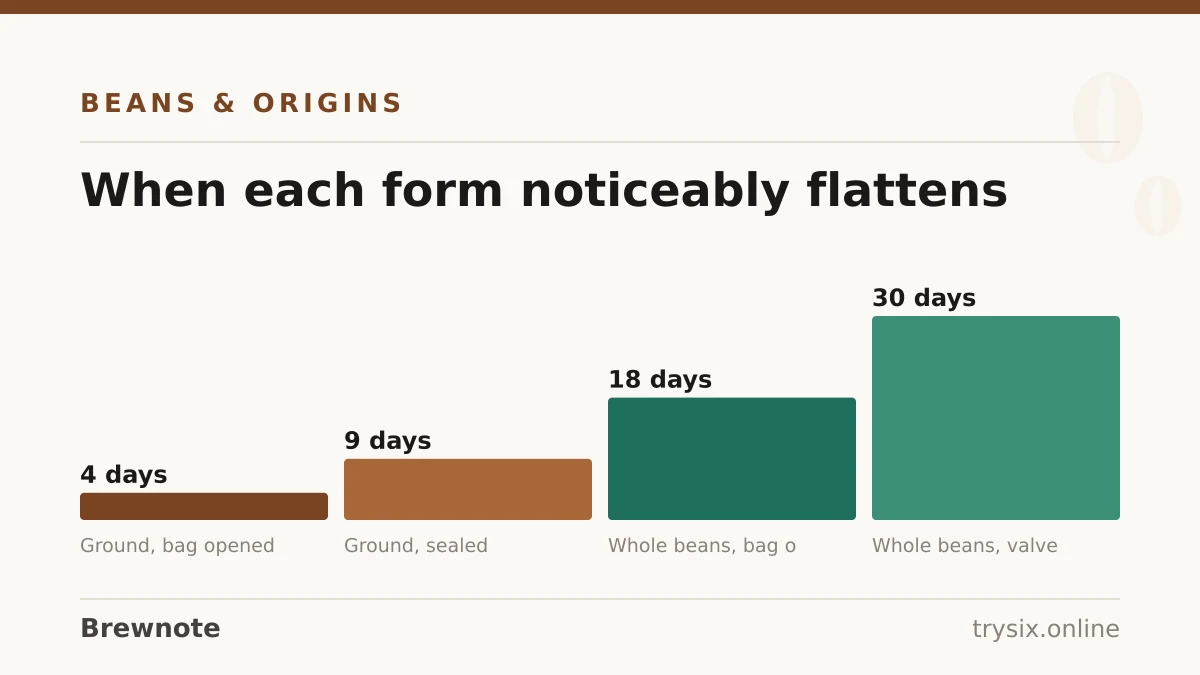
The trade-off is staling. Whole beans hold their character for weeks; ground coffee has vastly more surface area exposed to oxygen and noticeably flattens within about a week of grinding. If you are buying pre-ground, buy small bags often rather than one large one. How to store coffee beans covers keeping either form fresh, and where to buy coffee beans covers reading a roast date.
| Form | Noticeably flat after | Why |
|---|---|---|
| Whole beans, sealed with a valve | 3–5 weeks from roast | Low surface area; CO₂ still escaping |
| Whole beans, opened bag | 2–3 weeks | Oxygen ingress each time you open it |
| Ground, sealed | 7–10 days | Surface area is many times higher |
| Ground, opened | 3–5 days | Both effects at once |