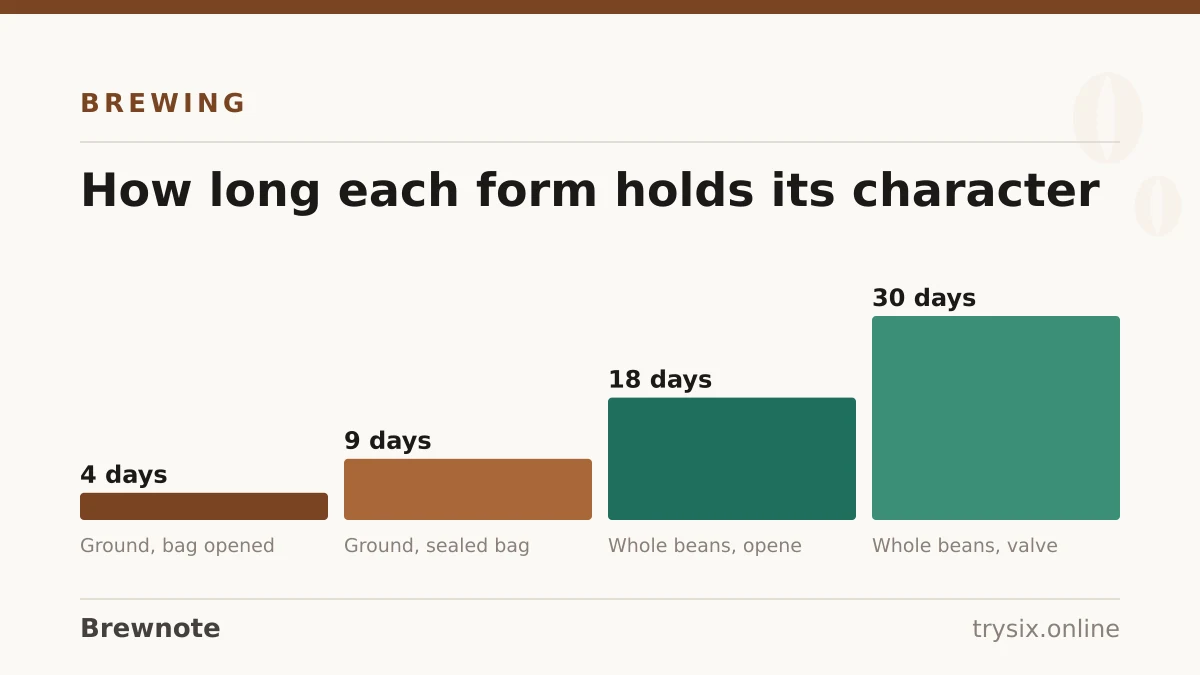
Ground coffee and instant coffee sit on the same supermarket shelf in similar-looking jars, and mixing them up produces a genuinely unpleasant surprise. They are not the same product, they are not used the same way, and one of them goes stale much faster than anyone expects.
What grinding is for
A whole roasted coffee bean is nearly impervious to water. Its soluble material — the acids, sugars, oils and caffeine that make up the drink — sits inside a rigid cellular structure. Steep a whole bean in hot water for an hour and you get faintly brown water.
Grinding breaks that structure open and creates surface area. A 15 g dose of medium-ground coffee has a surface area measured in square metres; the same 15 g of whole beans has a fraction of that. Extraction is a surface phenomenon, so the grind is what makes brewing possible at all.
Ground coffee versus instant
This is the distinction that confuses most people buying coffee for the first time, and the two products are not interchangeable in any way.
| Ground coffee | Instant coffee | |
|---|---|---|
| What it is | Roasted beans broken into particles | Brewed coffee, dried to crystals or powder |
| In water | Does not dissolve; must be filtered out | Dissolves completely |
| Preparation | Brew 3–6 minutes, discard grounds | Stir into hot water, done |
| Caffeine per 8 oz | About 95 mg | About 60–65 mg |
| Flavour | Full range of aromatic compounds | Much reduced by drying |
| Typical species | Often arabica | Frequently robusta or blends |
What the labels mean
Grind labels describe particle size, and they are not standardised. One roaster's medium is another's medium-fine. The words are still useful as a rough guide, and the household comparisons below are more reliable than the words themselves.
| Label | Looks like | Made for |
|---|---|---|
| Extra fine / Turkish | Flour | Ibrik/cezve brewing |
| Fine / espresso | Table salt | Espresso machines |
| Medium-fine | Fine sand | AeroPress, moka pot |
| Medium / drip / filter | Coarse sand | Drip machines, pour-over |
| Coarse | Raw sugar | French press, cold brew |
| Extra coarse | Coarse sea salt | Percolators, cowboy coffee |
A supermarket bag that says only 'ground coffee' is a medium drip grind. It works in a filter machine, works passably in a French press, will make a muddy cold brew, and will not work in an espresso machine at all. How to grind coffee beans has the full method-by-method chart.
How fast ground coffee stales
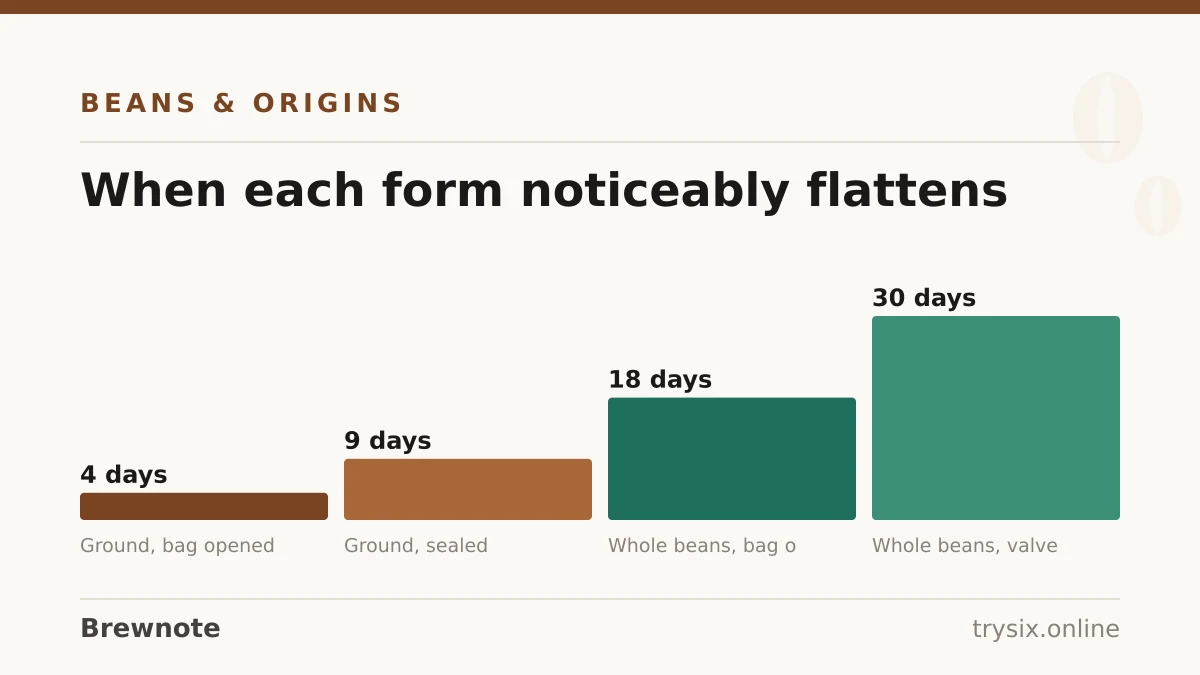
This is the real cost of buying pre-ground. Staling is oxidation, and oxidation happens at surfaces. Grinding turns a bean with a small outer surface into thousands of particles with an enormous combined one.
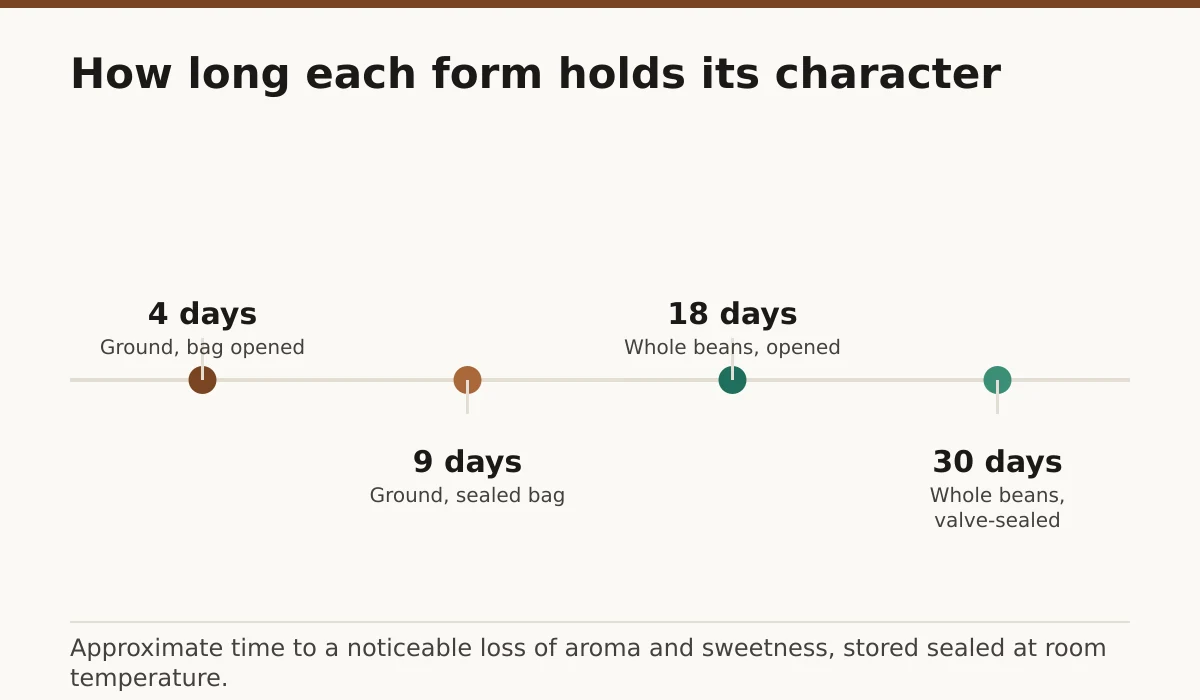
Research on coffee storage after opening finds measurable losses in volatile aroma compounds within days for ground coffee. It does not become unsafe — it becomes dull, losing sweetness and aroma first and eventually developing a flat, cardboard-like character. How to store coffee beans covers what actually helps, and what does not.
When pre-ground is the right choice
- You brew one method only, and you buy small bags often. Freshness is a function of turnover, not virtue.
- You have no grinder and no intention of buying one. A fresh bag of pre-ground beats stale beans ground badly in a blade grinder.
- You are travelling. A small vacuum-sealed bag survives a week in a suitcase far better than the alternative.
- You want convenience and know what you are trading. That is a legitimate choice, not a failure of standards.
Reading the bag
- Roast date, not best-before. A best-before date 18 months out tells you nothing about when the coffee was roasted. Where to buy coffee beans covers this in detail.
- A one-way degassing valve. Freshly roasted coffee releases CO₂ for weeks; a valve lets it out without letting oxygen in. Its presence signals a roaster who expects you to care.
- The grind, if stated. If it just says 'ground', assume medium drip.
- Species and roast level. Arabica or robusta, light or dark — see types of coffee beans and light vs dark roast.
- Bag size against your consumption. Buy what you will drink in three weeks, not what is on offer.
Once you have the right grind and a recent roast date, the remaining variables are ratio, water and time — all covered in how to make the perfect cup of coffee.