Decaf has a reputation problem, and a lot of it comes down to a vague sense that chemicals are involved. Some of that worry is fair and some of it is not, and the difference is worth understanding — mostly because it tells you which bag on the shelf is worth buying.
The shared principle
Every decaffeination method does the same three things. Steam or soak the green beans so they swell and the caffeine becomes mobile. Wash the caffeine out with something it dissolves into. Then dry the beans and return them for roasting.
The difficulty is that caffeine is not the only thing that dissolves. Sugars, acids and flavour precursors come out alongside it, which is why decaf historically tasted flat. The differences between the four methods are mostly about how well they put those compounds back or leave them alone.
The four processes
| Process | What removes the caffeine | Solvent-free | Reputation |
|---|---|---|---|
| Swiss Water | Water plus carbon filters | Yes | Best flavour retention; costlier |
| Supercritical CO₂ | Pressurised carbon dioxide | Yes | Very selective; used at scale |
| Ethyl acetate (sugarcane) | Ethyl acetate from fermented cane | Naturally derived | Slight fruity note; common in Colombia |
| Methylene chloride | Methylene chloride | No | Cheapest; the one that worries people |
Swiss Water
The most-marketed process, and the one most often named on speciality bags. Green beans are soaked in hot water, which pulls out both caffeine and flavour compounds. That water is passed through activated carbon filters sized to trap caffeine molecules while letting the flavour compounds through.
What is left is a caffeine-free but flavour-saturated water, called green coffee extract. A fresh batch of beans is soaked in it: because the water is already saturated with everything except caffeine, only caffeine diffuses out of the beans. The flavour compounds have nowhere to go.
- No chemical solvent at any stage — water and carbon only.
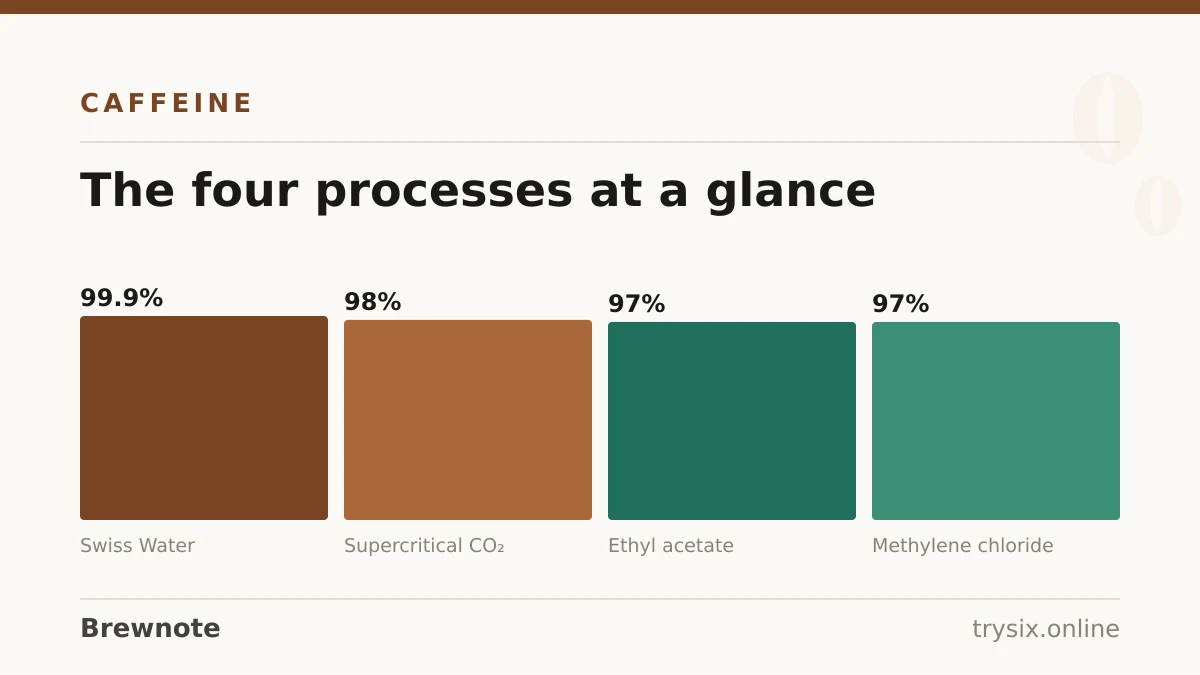
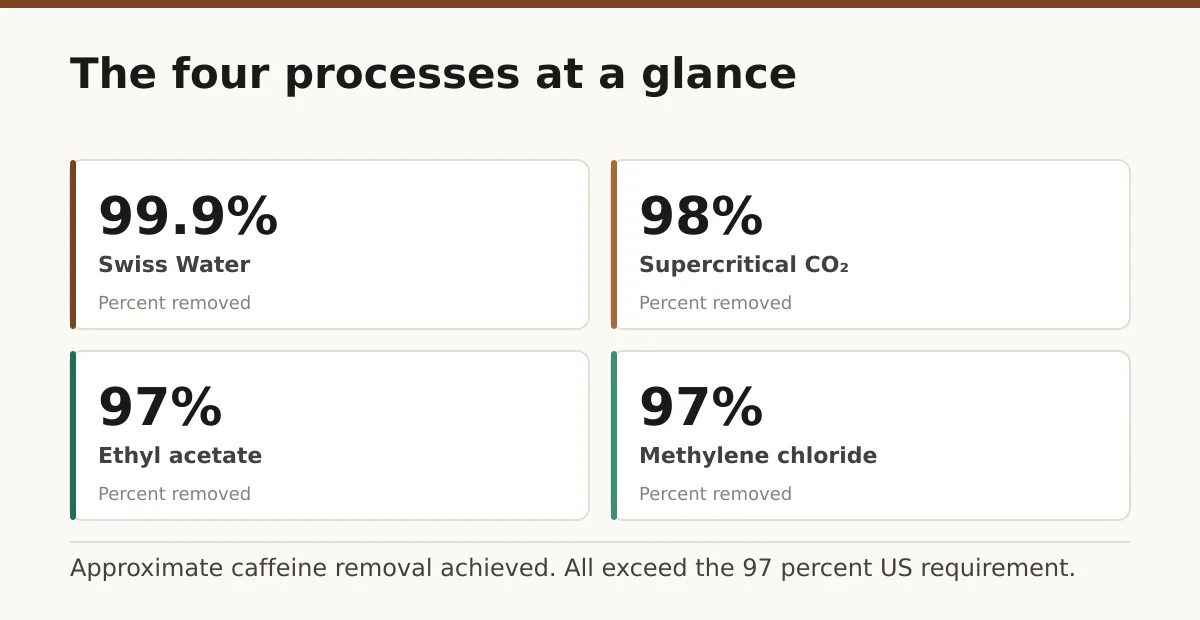
- Typically achieves 99.9 percent caffeine removal, above the 97 percent requirement.
- More expensive, which is why it appears mostly on speciality coffee.
- The name is a trademark; the underlying idea is a water process, and other companies run comparable ones.
Supercritical carbon dioxide
Carbon dioxide held above about 74 bar and 31°C becomes supercritical — neither properly liquid nor gas, with the density of a liquid and the diffusivity of a gas. In that state it is a highly selective solvent for caffeine and largely ignores the larger flavour molecules.
Steamed beans are held in a pressure vessel and the supercritical CO₂ is circulated through them. The caffeine-laden CO₂ is then depressurised, at which point the CO₂ returns to gas and the caffeine drops out — and that recovered caffeine goes into soft drinks and pharmaceuticals.
It is the method of choice for large-volume commercial decaf where flavour matters, because the equipment cost is high but the running cost per tonne is low.
Ethyl acetate — the 'sugarcane' process
Ethyl acetate is an ester that occurs naturally in ripening fruit and in fermented sugarcane, which is where the process gets its marketing name. Steamed beans are washed repeatedly with it; the caffeine dissolves into the solvent and is carried away, and the beans are then steamed again to drive off residual ethyl acetate.
It is common in Colombia, where sugarcane is abundant, and it often leaves a faint sweetness or fruitiness that some people like and others notice as an off-note. Because the solvent is naturally derived, it is frequently labelled 'natural decaf' — a description that is accurate but does more work in marketing than in chemistry.
Methylene chloride
The cheapest and historically most widespread method. Methylene chloride, also called dichloromethane, is applied either directly to the beans or indirectly to the water that has soaked them. It is very effective and highly selective for caffeine.
It also has a poor public reputation, and it is worth being precise about where the concern sits. US regulations cap residual methylene chloride in roasted decaf at 10 parts per million. Measured residues in finished coffee are typically far below that, partly because the compound boils at around 40°C and roasting takes the beans past 400°F — several hundred degrees above its boiling point.
What this means for buying decaf
Choosing a decaf worth drinking
Step 1: Look for a named process
Swiss Water, CO₂ or sugarcane/ethyl acetate. A roaster who names the process generally chose it, which is itself a signal about the rest of the coffee.
Step 2: Check the roast date
Decaf has been through more handling and more shipping than regular coffee before roasting. It stales the same way afterwards — see how to store coffee beans.
Step 3: Prefer medium roasts
Decaffeinated beans are structurally more fragile and roast faster, so they scorch easily. Dark decaf is frequently over-roasted, which is where a lot of decaf's bad reputation comes from.
Step 4: Adjust your grind
Decaf beans are more brittle and grind finer at the same setting, which can push a brew into over-extraction. Going one step coarser is often the fix — see how to grind coffee beans.
Whatever the process, the result still contains a small amount of caffeine by design — around 2 mg in an 8 oz cup. Does decaf coffee have caffeine covers what the residue means in practice.