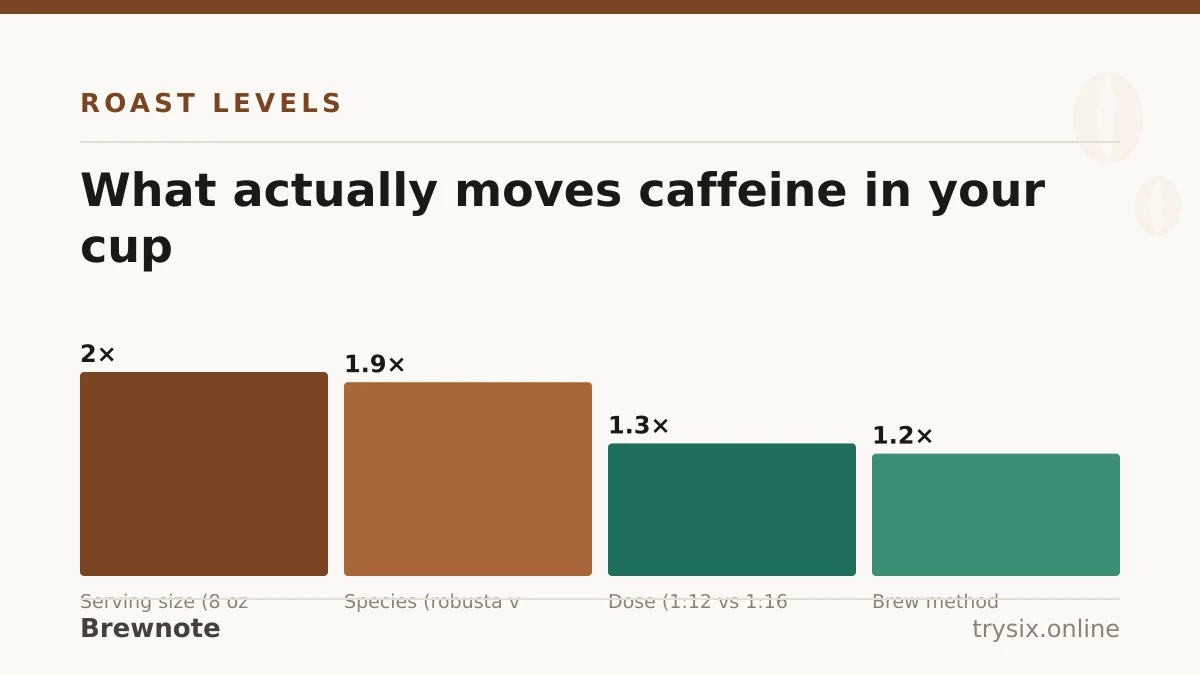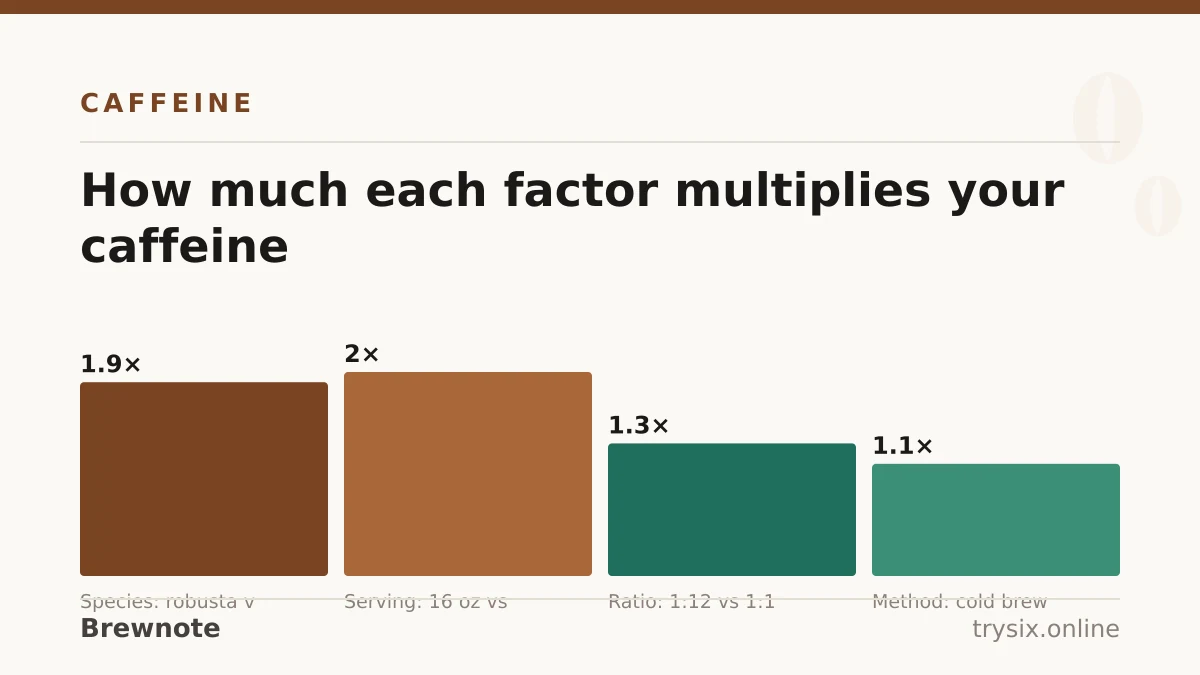
If you want a stronger hit, most advice sends you towards dark roast or a particular brewing method. Both are close to irrelevant. The things that actually move the number are simpler, larger, and mostly under your control at the point of buying.
Rank the levers, not the drinks
Most articles on this question rank drinks. That is the wrong frame, because the same drink varies enormously depending on how it was made. What is stable is the ranking of the variables.
Species: the biggest difference
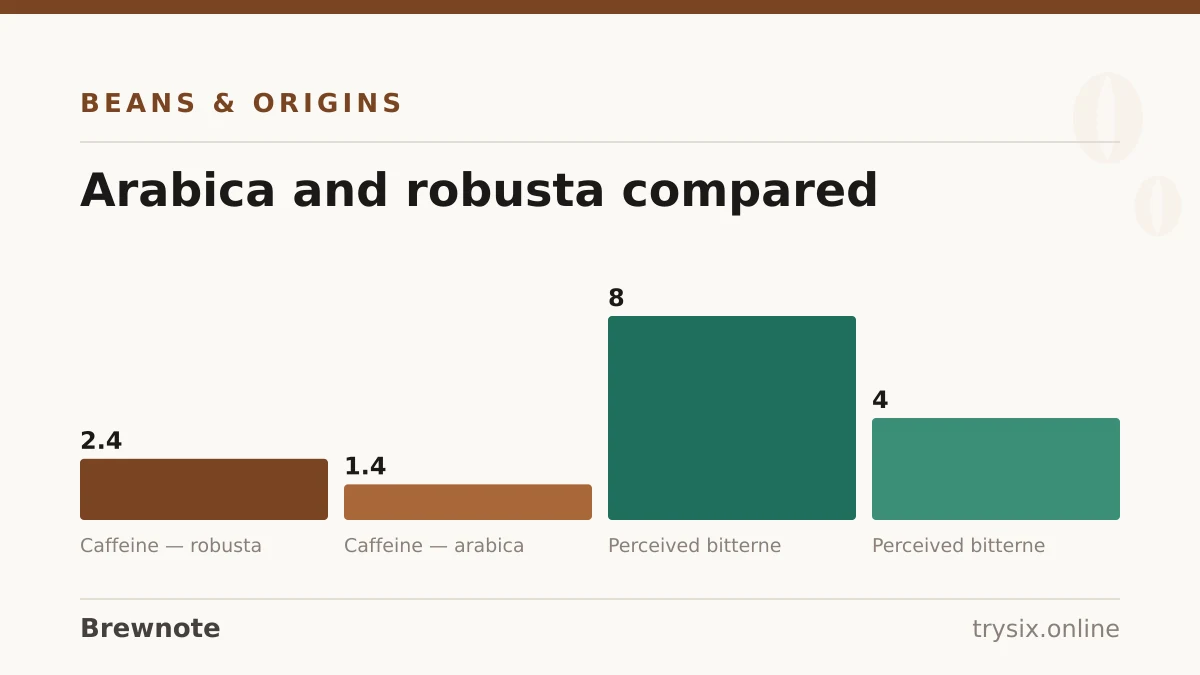
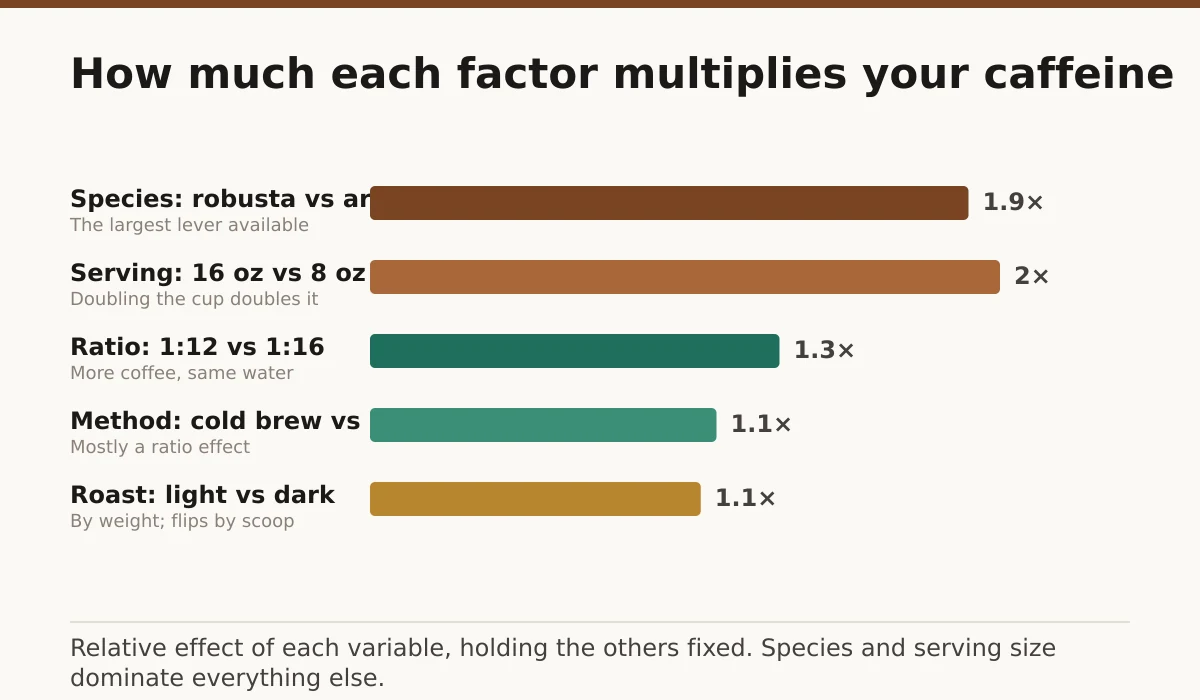
Coffea canephora, sold as robusta, contains roughly twice the caffeine of Coffea arabica by weight. Caffeine acts as a natural insecticide in the plant, and robusta's higher concentration is part of why it is hardier and grows at lower altitudes.
| Arabica | Robusta | |
|---|---|---|
| Caffeine by weight | ~1.2–1.5% | ~2.2–2.7% |
| Share of world production | Majority | Most of the remainder |
| Grown at | Higher altitude | Lower altitude |
| Tastes | Sweeter, more acidic, aromatic | Harsher, grainy, rubbery |
| Crema in espresso | Moderate | Abundant |
| Typical use | Speciality and most supermarket coffee | Instant, espresso blends, budget coffee |
Robusta is not simply worse — well-grown robusta is a legitimate product, and Italian espresso blends have used it for body and crema for a century. But most robusta is grown for volume, and its reputation follows from that. Types of coffee beans covers the species properly.
Serving size: the one people forget
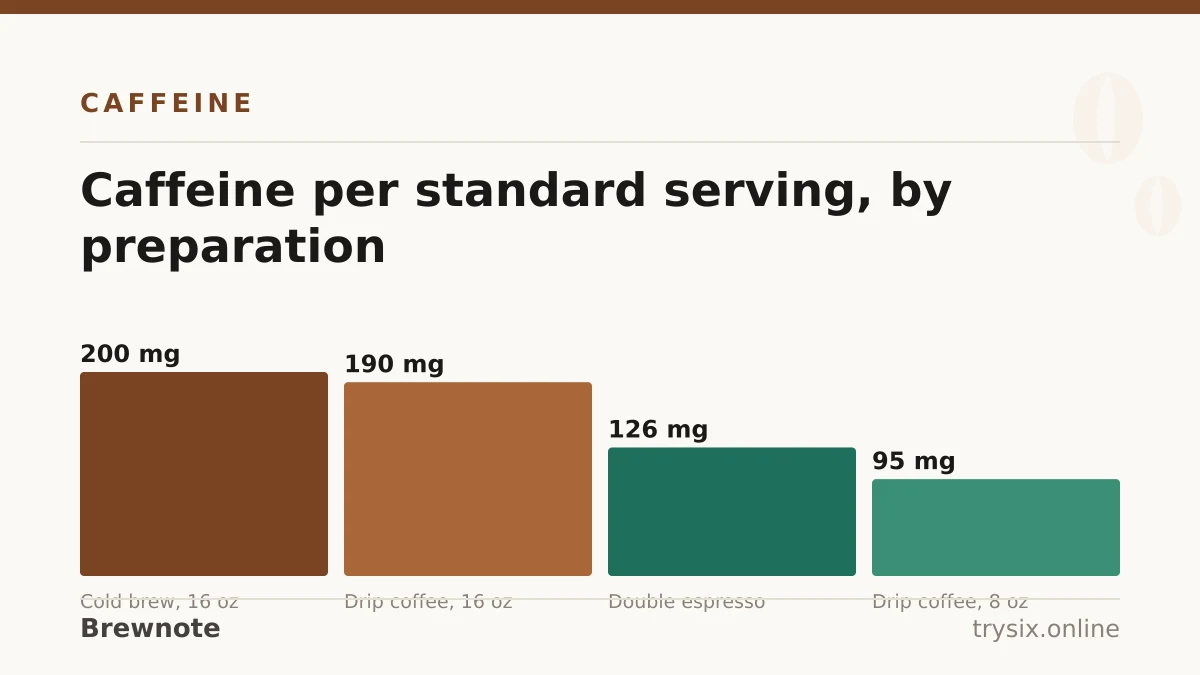
Nothing else on this page changes caffeine as cleanly as how much you drink. An 8 oz cup of drip is about 95 mg; a 16 oz is about 190; a 20 oz travel cup is about 235. No brewing decision competes with that.
This is also why 'espresso has the most caffeine' is a misleading claim. Per millilitre it does, by a wide margin. Per serving it does not, because a shot is 30 ml. How much caffeine is in a cup of coffee has the full table.
Brew method, ranked honestly
| Drink | Serving | Caffeine | Why |
|---|---|---|---|
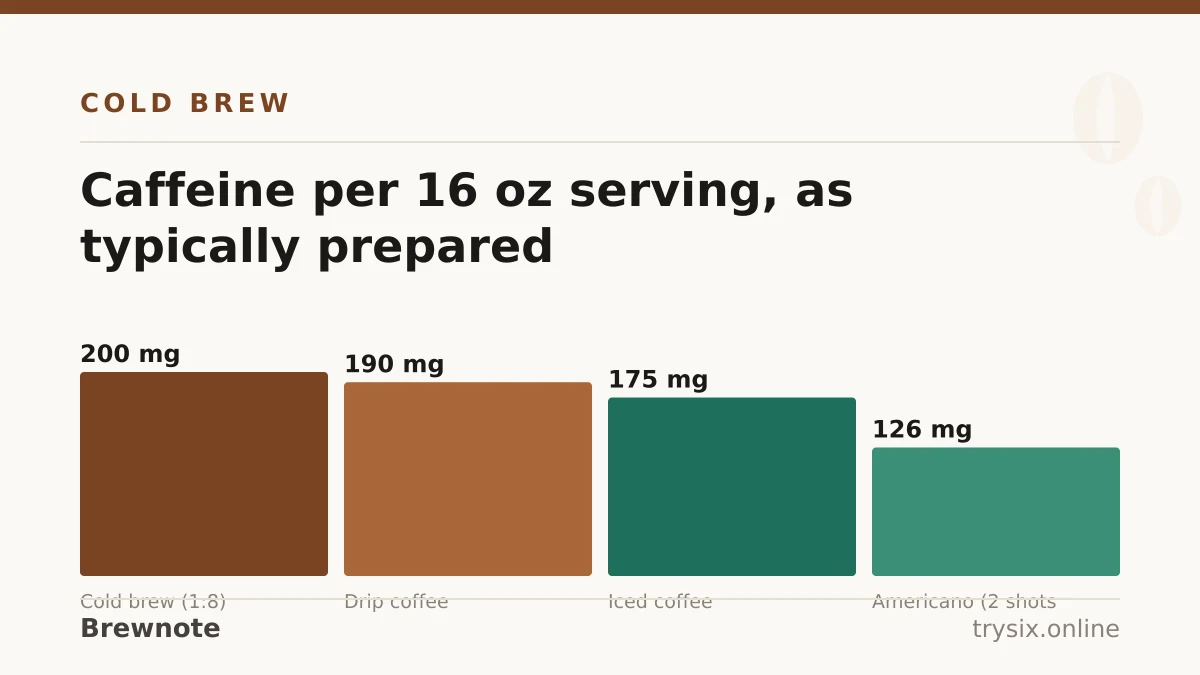
| Cold brew | 16 oz | 150–240 mg | Brewed at 1:8, not 1:16 |
| Drip coffee | 16 oz | ~190 mg | Standard ratio, large cup |
| French press | 8 oz | ~100 mg | Long immersion, full extraction |
| Double espresso | 60 ml | ~126 mg | High concentration, small volume |
| Drip coffee | 8 oz | ~95 mg | The reference figure |
| Instant | 8 oz | ~62 mg | Lower dose per cup |
| Single espresso | 30 ml | ~63 mg | Tiny serving |
| Decaf | 8 oz | ~2 mg | 97% removed by regulation |
Cold brew tops the list not because cold water extracts more — it extracts less efficiently than hot — but because it is conventionally brewed at roughly twice the coffee-to-water ratio. Is cold brew stronger covers that distinction.
Roast level: the argument not worth having
Light roast has marginally more caffeine by weight, because roasting degrades a small amount. Dark roast often has more by scoop, because the beans are less dense and more fit in a spoon. The difference is a few percent either way.
Measurements comparing green and roasted coffee find caffeine to be comparatively heat-stable — it survives roasting far better than chlorogenic acids, which are substantially degraded. That is why acidity changes dramatically across roast levels while caffeine barely moves. Light vs dark roast sets out the arithmetic.
Getting more, or less
Adjusting deliberately
Step 1: To get more caffeine
Buy a blend containing robusta, brew at 1:12 rather than 1:16, and use a larger cup. Those three together roughly triple a standard 8 oz arabica drip cup.
Step 2: To get less without switching to decaf
Smaller servings and pure arabica. A single espresso is about 63 mg — less than a cup of drip coffee, despite tasting far stronger.
Step 3: To get very little
Decaf, at about 2 mg per cup. It is not zero; does decaf coffee have caffeine explains why and by how much.
Step 4: To know what you are actually drinking
Brew at home with a weighed dose. Café drinks are the least predictable source, with dose and shot count varying by branch.
Whatever direction you are going, the FDA's 400 mg per day reference for healthy adults is the usual anchor — and it does not apply during pregnancy, to children, or to people with certain cardiac or anxiety conditions.