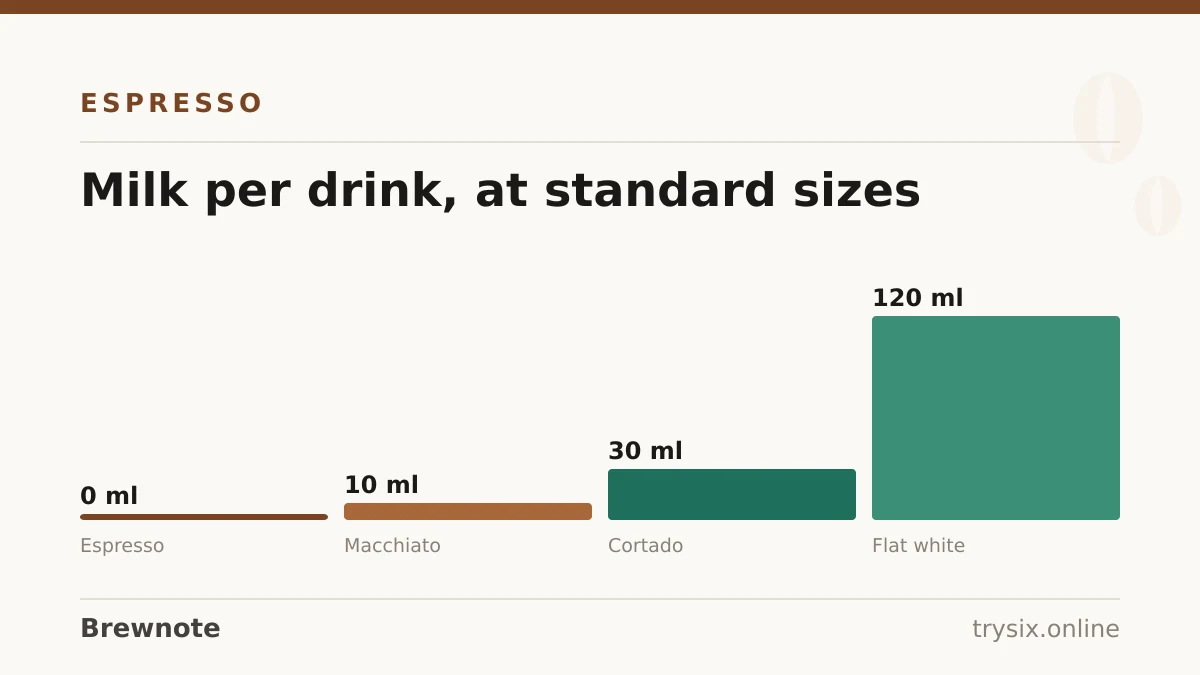
A café menu looks like a list of twelve unrelated drinks you are expected to already understand. It is really one drink with different amounts of milk. Once you can see the pattern, you can predict what anything on the board will taste like and order exactly what you want.
One axis explains the whole menu
Café menus look like a list of unrelated drinks. They are not. With a handful of exceptions, every one is espresso with something added, and the drinks line up neatly along a single axis: how much milk, and how it was textured.
Once you see that, the menu becomes predictable. A macchiato is the least milk; a latte is the most. Everything else sits between them.
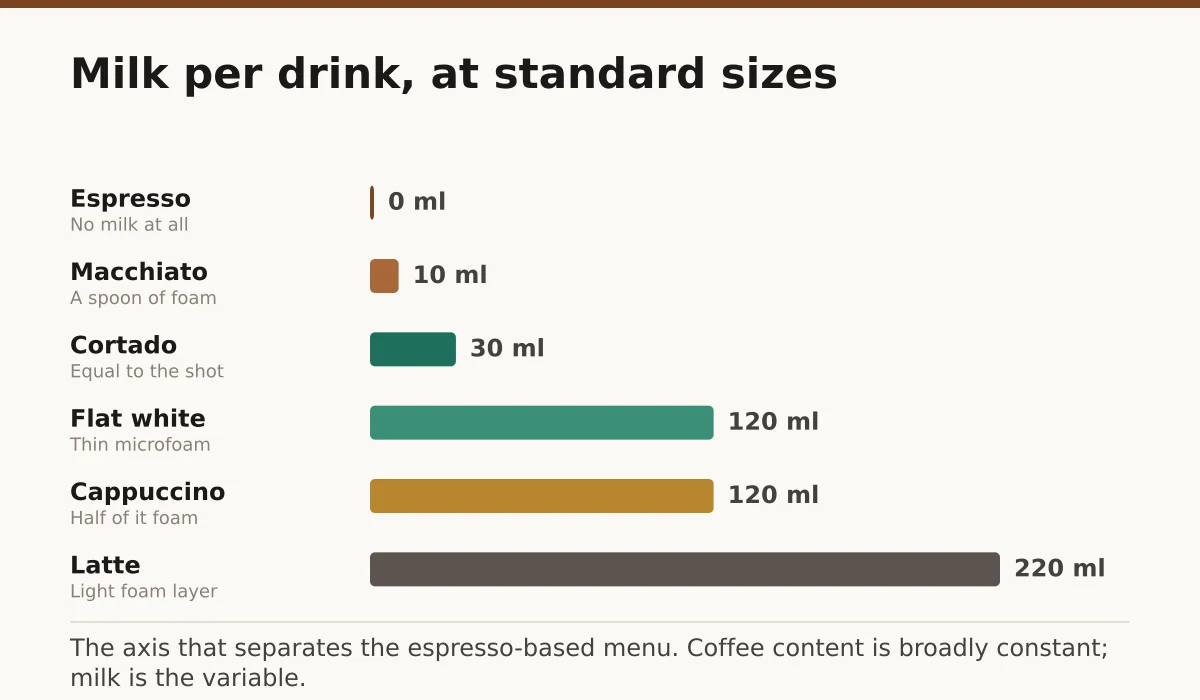
The espresso-based drinks
| Drink | Espresso | Milk | Foam | Total |
|---|---|---|---|---|
| Espresso | 1–2 shots | None | Crema only | 30–60 ml |
| Macchiato | 1 shot | None | A spoon | ~40 ml |
| Cortado | 1 shot | ~30 ml steamed | Minimal | 60–90 ml |
| Piccolo | 1 shot | ~60 ml steamed | Thin | ~90 ml |
| Flat white | 2 shots | ~120 ml steamed | Thin microfoam | 150–180 ml |
| Cappuccino | 1–2 shots | ~60 ml steamed | ~60 ml foam | 150–180 ml |
| Latte | 1–2 shots | ~200 ml steamed | ~1 cm foam | 240–350 ml |
| Mocha | 1–2 shots | ~200 ml steamed | Often cream | 240–350 ml |
| Americano | 1–2 shots | None | None | 150–350 ml |
The distinctions people get wrong
- Cappuccino versus latte: the coffee is identical. A cappuccino has roughly equal parts steamed milk and dry foam; a latte is mostly steamed milk with a thin foam cap.
- Macchiato: in a café it means an espresso 'marked' with a spoonful of foam — a tiny, intense drink. The large sweetened iced versions sold by chains are unrelated to it.
- Americano versus lungo: an americano is a normal shot with hot water added afterwards. A lungo runs extra water through the grounds during extraction, which extracts more bitterness. See what is an espresso shot.
- Latte in Italy: ordering a 'latte' in Italy gets you a glass of milk. The drink is a caffè latte.
- Café au lait: not espresso-based at all — brewed coffee with scalded milk. What is café au lait covers it.
What milk texture actually is
Steaming does two things at once. It heats the milk, and it injects air into it, forming a foam of tiny bubbles suspended in the liquid. Heating also denatures milk proteins, which stabilise those bubbles, and releases perceived sweetness as lactose becomes more noticeable at around 140°F.
Why the same milk becomes three different textures
Step 1: Microfoam — flat white, latte art
Air introduced briefly at the start, then the steam wand submerged to spin the milk. The bubbles are too small to see individually, giving a glossy, paint-like texture that pours.
Step 2: Dry foam — cappuccino
More air, introduced for longer, producing visibly larger bubbles and a stiffer foam that sits on top rather than mixing in. This is what gives a cappuccino its distinct layers.
Step 3: Barely textured — cortado
Heated with minimal aeration. The point of a cortado is to cut the espresso's acidity with milk, not to add texture.
Step 4: Overheated — the common fault at home
Past about 160°F the proteins break down, the foam collapses, and the milk starts to taste cooked and flat. Milk for coffee should be steamed to roughly 140–150°F, not to boiling.
Iced and cold drinks
| Drink | Base | Note |
|---|---|---|
| Iced latte | Espresso, cold milk, ice | Not a chilled hot latte; never steamed |
| Iced americano | Espresso, cold water, ice | Cleanest way to drink espresso cold |
| Iced coffee | Hot-brewed coffee, chilled | Brew at double strength — how to make iced coffee |
| Cold brew | Steeped 12–24 h, never heated | A different extraction — cold brew vs iced coffee |
| Affogato | Ice cream with a shot poured over | Dessert; usually a single shot |
Non-espresso coffee drinks
Not everything on a menu comes from the machine. Filter or batch brew is drip coffee, brewed at about 1:16 and served black or with a splash of milk. Turkish coffee is extremely finely ground coffee simmered with the water and served unfiltered, grounds and all. Instant is dried, previously brewed coffee.
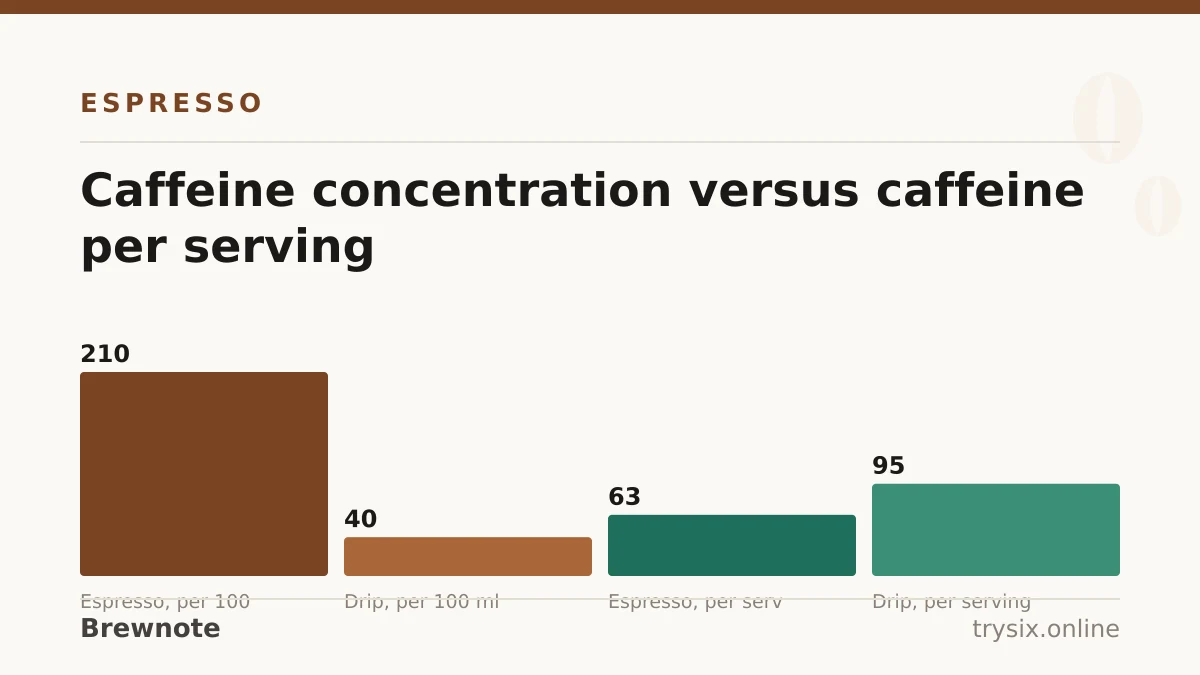
These sit outside the milk axis entirely, and they taste different for structural reasons rather than stylistic ones — a filter coffee is roughly a tenth as concentrated as espresso, which lets individual origin flavours separate out instead of arriving all at once. Espresso vs coffee works through that comparison.