Coffee bags promise blueberry and jasmine, you taste coffee, and it is easy to conclude your palate is broken. It is not. There is a real thing being described, it is subtler than the packaging implies, and there are four straightforward things to notice that make any cup easier to describe.
The four axes
Professional coffee tasting uses long vocabularies, but nearly everything useful fits on four axes. Learn to place a cup on each and you can describe any coffee well enough to buy the next one deliberately.
| Axis | What it is | Reads as | Increased by |
|---|---|---|---|
| Acidity | Perceived brightness | Citrus, apple, wine | Light roast, high altitude, washed processing |
| Sweetness | Perceived sugar | Caramel, honey, fruit | Ripe cherries, good extraction |
| Bitterness | Perceived bitter compounds | Cocoa, char, burnt | Dark roast, over-extraction, fine grind |
| Body | Weight and texture | Thin, syrupy, creamy | Natural processing, immersion brewing, metal filters |
What the tasting notes on a bag mean
A bag saying 'blueberry, dark chocolate, jasmine' is not telling you anything was added. Roasted coffee contains hundreds of volatile aromatic compounds, and some of them are chemically the same molecules found in those foods. The roaster tasted the coffee and reached for the closest reference.
Two honest caveats. Those notes are usually far subtler than the packaging suggests, and they are easiest to detect in light-roast coffee brewed as filter — dark roasting destroys most of them, as what is dark roast coffee explains. And tasting is suggestible: research on flavour perception consistently finds that expectation shapes what people report tasting, so reading the notes before drinking makes you more likely to find them.
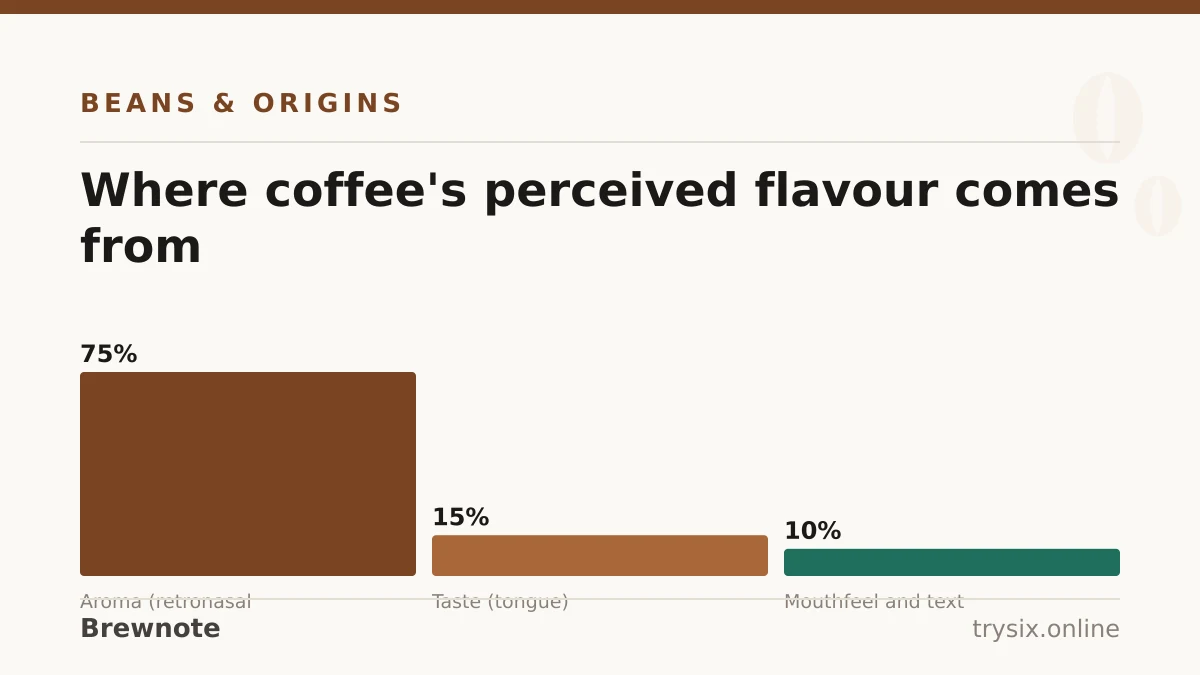
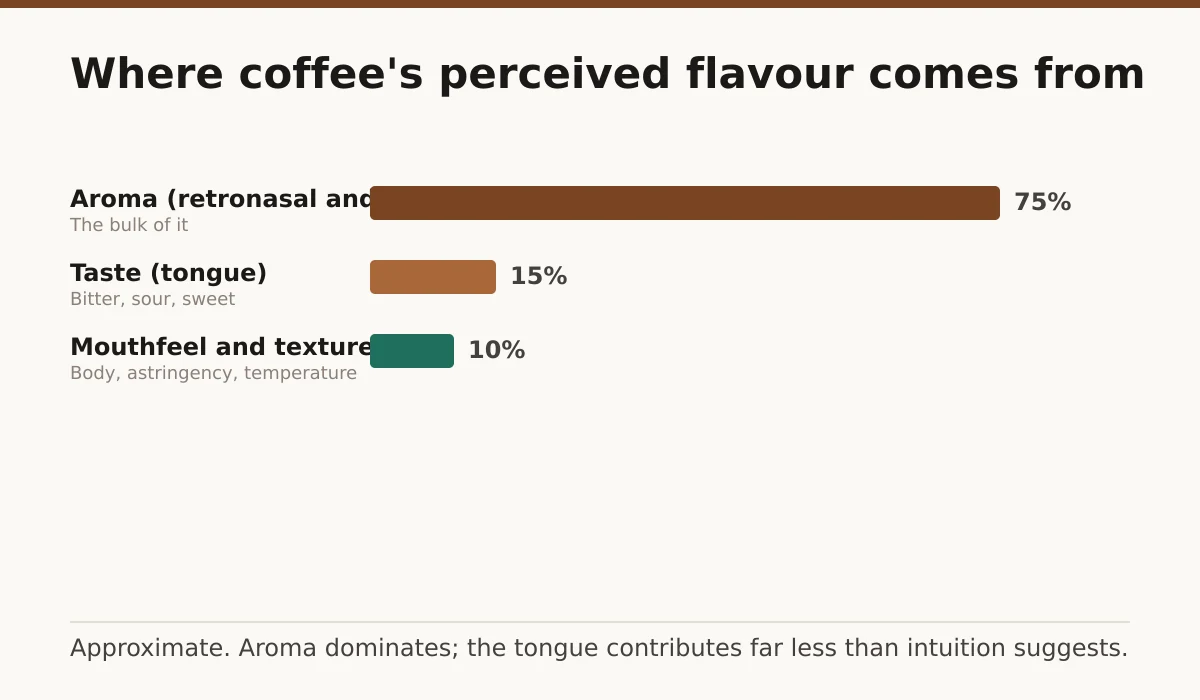
Taste is mostly smell
The tongue detects five things: sweet, sour, salty, bitter and umami. Everything else you experience as flavour is aroma, detected by receptors in the nasal cavity — both by sniffing and retronasally, as air passes from your mouth up behind your palate as you swallow.
That is why coffee tastes almost blank when you have a cold, and why holding your nose while sipping reduces a complex cup to bitter-and-a-bit-sour. It is worth trying once: it makes the point better than any explanation.
How origin shows up
| Origin | Typical character | Acidity | Body |
|---|---|---|---|
| Ethiopia | Floral, citrus, tea-like | High | Light |
| Kenya | Blackcurrant, tomato, savoury | Very high | Medium |
| Colombia | Caramel, red apple, balanced | Medium | Medium |
| Brazil | Nuts, cocoa, low acid | Low | Heavy |
| Sumatra | Earthy, herbal, cedar | Low | Very heavy |
| Guatemala | Cocoa, spice, orange | Medium-high | Medium |
These are tendencies rather than rules, and they only show through in light and medium roasts. Where do coffee beans come from covers the geography, and how coffee is made covers how processing — washed, natural or honey — shifts the cup as much as origin does.
Diagnosing a bad cup
Most complaints about coffee's taste are brewing faults rather than preferences, and they have specific fixes.
What each fault means
Step 1: Sour, thin, salty, finishes fast
Under-extracted. Grind finer, use hotter water, or brew longer. This is the single most common home-brewing fault and it is often mistaken for 'I don't like this coffee'.
Step 2: Bitter, harsh, drying, lingers unpleasantly
Over-extracted. Grind coarser, cool the water slightly, or shorten the brew. Very fine grinds and long contact times are the usual causes.
Step 3: Sour and bitter at the same time
Uneven extraction. Some grounds over-extracted while others under-extracted — usually caused by inconsistent particle size from a blade grinder, or an uneven bed. No single adjustment fixes this; see how to grind coffee beans.
Step 4: Flat, dull, papery, tastes of nothing much
Stale coffee, or stale water. Check the roast date; coffee flattens within weeks. Also use fresh cold water — reboiled water tastes noticeably duller.
Step 5: Weak but not sour
Too little coffee. This is a ratio problem, not an extraction one. Weigh your dose rather than scooping.
If a cup falls into none of these categories and you simply do not enjoy it, that is a genuine preference and worth acting on — try a different roast level or origin rather than persisting.
Training your palate
- Taste two coffees side by side. Differences are easy to notice and almost impossible to describe in isolation.
- Drink some black, at least at first. Milk and sugar flatten acidity and mask most of what distinguishes one coffee from another.
- Let it cool. Coffee changes markedly as it drops from scalding to warm, and acidity and sweetness both become clearer.
- Slurp. It aerates the coffee and drives aroma up the retronasal passage, which is why professional tasters do it audibly.
- Write one sentence per coffee. Vocabulary develops through use, not through reading tasting wheels.
If you are starting out, the best coffee for beginners suggests a starting path, and how to make the perfect cup of coffee covers the variables that decide whether any of this reaches your cup at all.