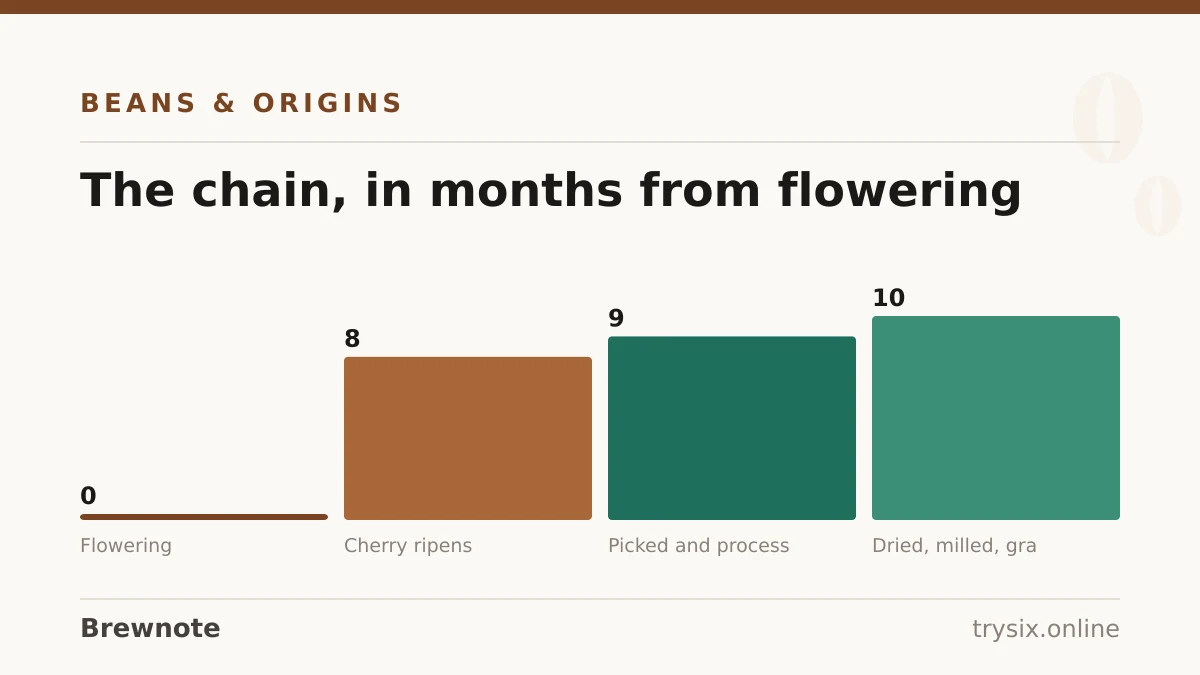
Coffee is the second thing most of us do every morning and one of the least examined. It is a fruit seed, roasted until it develops a flavour it did not previously have, then steeped in water. Everything anyone argues about is one of those steps, and this page is the map.
The plant
Coffee grows on evergreen shrubs of the genus Coffea, which in cultivation are usually kept to two or three metres so the fruit can be picked. The plants flower white and fragrant, and the fruit that follows takes seven to nine months to ripen from green to deep red.
Each cherry contains two seeds, flat sides facing each other. Those seeds are what we call coffee beans, and they are the only part used. Occasionally a cherry produces a single rounded seed instead of two — a peaberry — which some roasters separate and sell on its own.
From cherry to cup
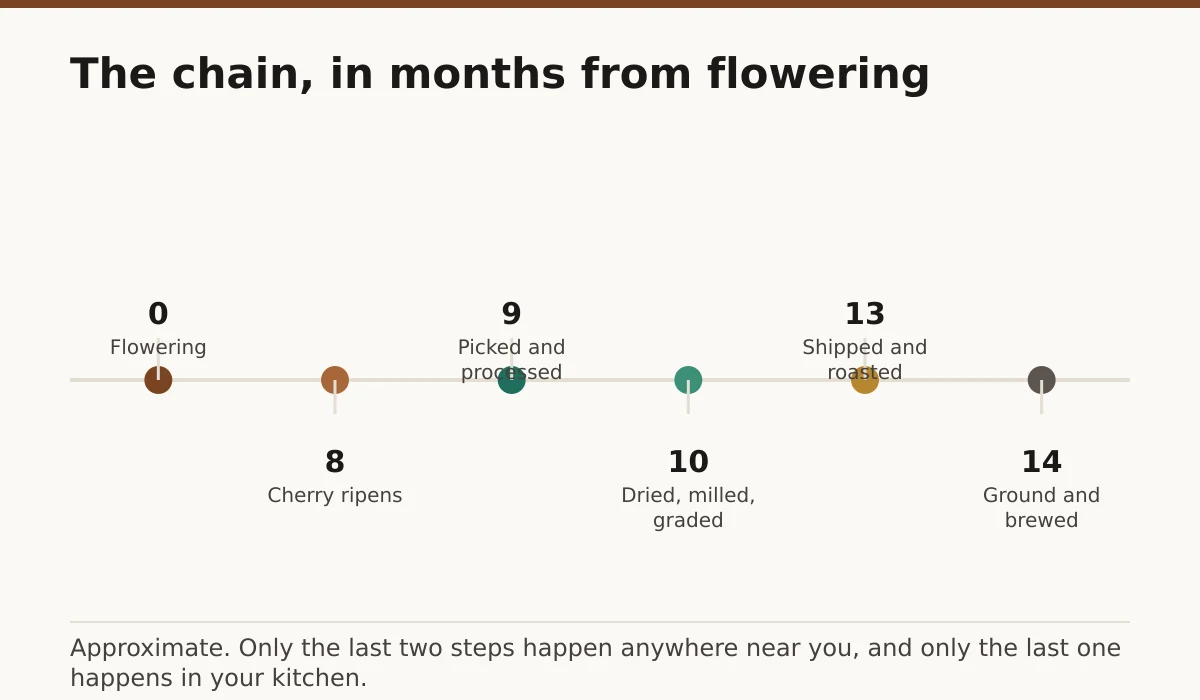
Most of that chain is invisible to the drinker, and most of the flavour is decided in it. How coffee is made follows the processing steps in detail, and where do coffee beans come from covers the geography.
The two species
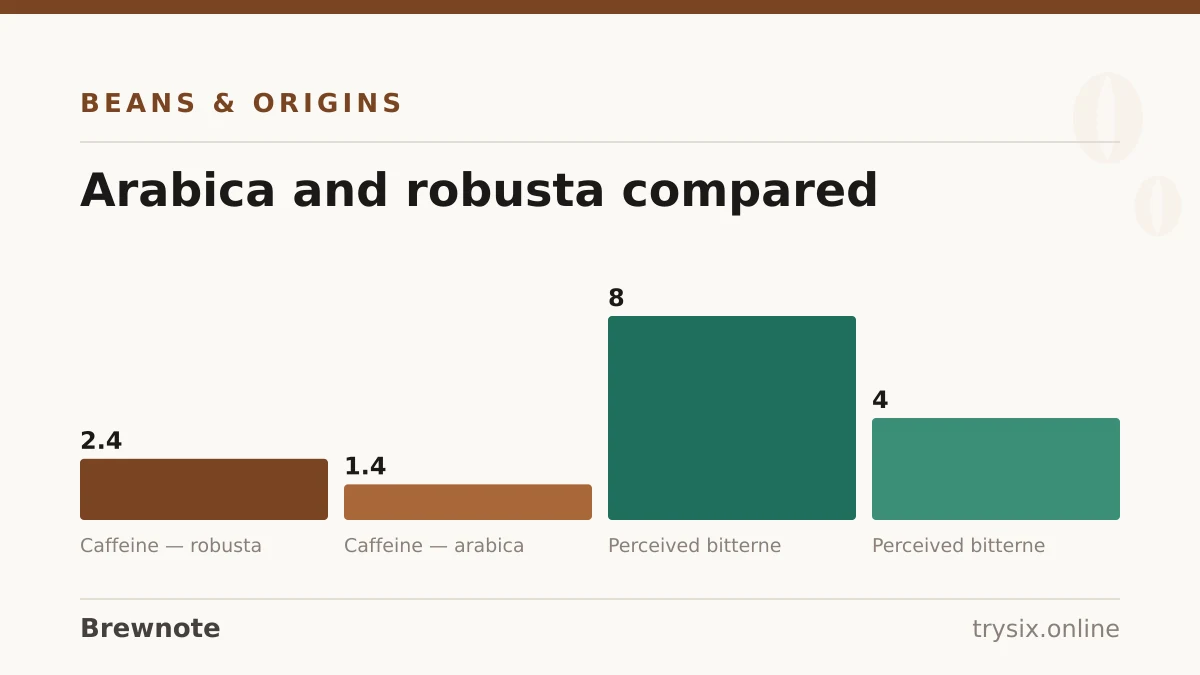
| Arabica | Robusta | |
|---|---|---|
| Share of world production | Majority | Most of the remainder |
| Caffeine by weight | ~1.2–1.5% | ~2.2–2.7% |
| Grows at | Higher altitude, cooler | Lower altitude, hotter |
| Disease resistance | Lower | Higher |
| Flavour | Sweeter, acidic, aromatic | Harsher, grainy, more bitter |
| Typical use | Speciality and most bagged coffee | Instant, espresso blends, budget |
Two further species, liberica and excelsa, exist commercially but in very small volumes. Types of coffee beans covers all four and what 'single origin' and 'blend' actually mean.
Why roasting matters
Green coffee beans are dense, pale and taste of hay. Everything recognisable as coffee flavour is created by roasting, which drives off moisture and triggers the Maillard reaction and caramelisation, building hundreds of aromatic compounds that were not present before.
How far you take that process is the roast level. Stop shortly after first crack, around 385°F, and you have a light roast that keeps the character of where it grew. Carry on to second crack near 435°F and you have a dark roast where roast flavour dominates. Neither is better; they are different trades.
What brewing actually is
Brewing is extraction: water dissolving soluble material out of ground coffee. About 30 percent of a roasted bean is water-soluble, and a well-made cup extracts around 18 to 22 percent of the bean's mass. Below that range the cup tastes sour and thin; above it, bitter and harsh.
Every brewing method is a different way of controlling how much gets extracted and into how much water. That is why the same beans taste so different as espresso and as filter — one dissolves a similar proportion into a fraction of the water.
| Method | Mechanism | Ratio | Time |
|---|---|---|---|
| Drip / pour-over | Gravity through a filter bed | 1:16 | 3–6 min |
| French press | Full immersion, mesh filter | 1:16 | 4 min |
| Espresso | ~9 bar pressure | 1:2 | 25–30 sec |
| Moka pot | ~1.5 bar steam pressure | 1:8 | 3–5 min |
| Cold brew | Cold immersion | 1:8 or stronger | 12–24 h |
| Instant | Already brewed, then dried | n/a | Seconds |
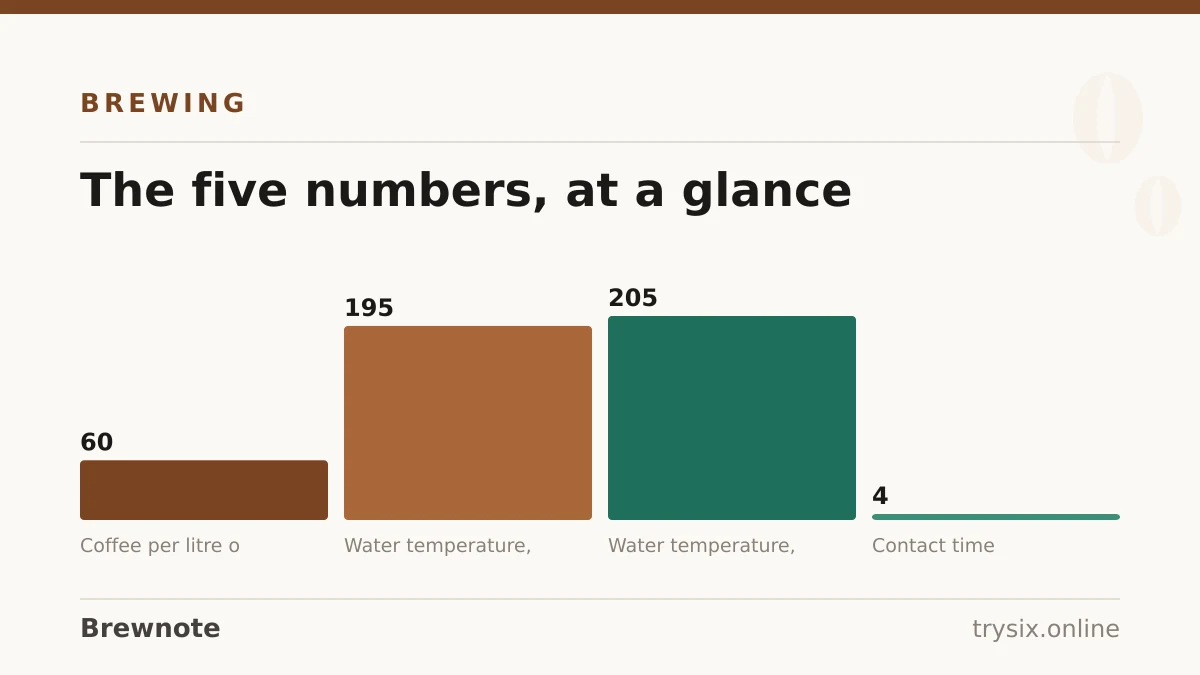
If you only read one other page here, make it how to make the perfect cup of coffee — it covers the five variables that decide nearly everything about how a cup tastes.
Caffeine
Caffeine is a natural insecticide the plant produces, and it is why anyone drinks coffee in the morning. An 8 oz cup of brewed coffee averages about 95 mg; a single espresso shot about 63 mg; a cup of decaf about 2 mg.
Those averages hide a wide spread, because dose, species, grind and brew time all move the figure. The FDA cites 400 mg a day as not generally associated with negative effects for healthy adults — a population reference that does not apply during pregnancy, to children, or to people with certain cardiac or anxiety conditions. How much caffeine is in a cup of coffee has the full tables.
Where to go from here
- Making it better: how to make the perfect cup of coffee and how to grind coffee beans.
- Making it without equipment: how to make coffee without a coffee maker.
- Understanding espresso: what is espresso and types of coffee drinks.
- Buying beans: where to buy coffee beans and the best coffee for beginners.
- Keeping it fresh: how to store coffee beans.